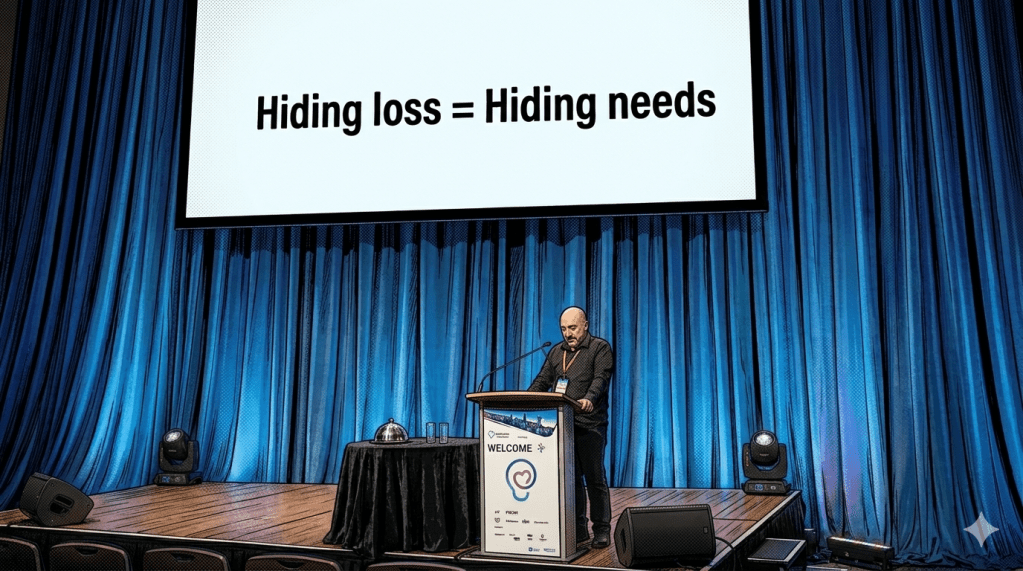
On 23rd April 2026, I had the honour of being the opening presenter at the Australian College of Audiology incorporating HAASA Conference in Broadbeach, Queensland.
The presentation explored something I’ve spent much of my life trying to understand, both personally and professionally, what hearing loss actually feels like to live with.
Not what appears on an audiogram.
Not what we measure in a clinic room.
But the lived reality behind it all: the effort, fatigue, misunderstanding, isolation, and quiet persistence required to navigate a world that rarely stops to accommodate invisible challenges.
This is an adapted and expanded version of that presentation, rewritten for a blog format while staying true to the stories and experiences shared on the day.
What does hearing loss actually feel like?
When most people think about hearing loss, they imagine a simple reduction in volume, as though the world slowly gets quieter, like turning down a dial on a stereo.
But that isn’t what hearing loss actually feels like.
It’s far more complex than that.
In reality, hearing loss is often about inconsistency rather than silence. It’s hearing parts of conversations but missing key words. It’s reconstructing meaning from fragments. It’s relying heavily on context, facial expressions, and educated guesses just to keep up with what is being said.
And perhaps most significantly, it’s exhausting in a way that is difficult to explain unless you’ve experienced it.
For much of my life, I lived in a space between what could be measured and what could be experienced. From the outside, I often appeared to be managing well enough. I could participate in conversations, respond appropriately, and function in daily life.
But internally, every interaction required effort. Constant effort.
That disconnect between appearance and lived experience is something many people with hearing loss will recognise. Because hearing loss is invisible, the struggle often goes unseen. What people observe is someone seemingly coping. What they don’t see is the cognitive load required to make that possible.
Over time, many people with hearing loss become highly skilled at compensating. I certainly did.
I learned to laugh at the right moments, even when I hadn’t heard the joke. I became adept at reading body language and conversational rhythm. I nodded along in meetings and classrooms, hoping I wouldn’t be called on to respond to something I hadn’t fully understood.
At the time, I thought I was adapting well.
Looking back now, I understand I was simply working harder than most people around me ever realised.
Growing Up With Hearing Loss
I was diagnosed with hearing loss at the age of thirteen.
Interestingly, my mother had also been diagnosed around the same age, and her experience shaped much of how hearing loss was understood in our family. She underwent surgery in an attempt to restore her hearing, but it was unsuccessful and resulted in complete hearing loss in one ear.
More impactful than the medical outcome, however, was the emotional response that followed. Hearing loss became something associated with embarrassment and concealment — something to be managed quietly rather than acknowledged openly.
Without realising it at the time, I internalised that perspective.
Hearing loss was not something you talked about.
It was something you hid.
So when I was fitted with my first hearing aid at fourteen, I didn’t feel relief. I felt discomfort. Not because of the device itself, but because of what I believed it represented.
At that age, fitting in meant everything. The idea of wearing a hearing aid at school felt like an unwanted spotlight, drawing attention to the very thing I was trying to keep hidden.
So I didn’t wear it.
It stayed in a drawer.
What should have been a tool for connection instead became a symbol of difference I wasn’t ready to acknowledge.
Looking back now, I often think about how differently that moment might have felt with a more open understanding of hearing loss. But at the time, I only understood it through the lens of adolescence — where difference often feels like something to avoid at all costs.
So I did what many people with invisible challenges learn to do.
I compensated.
And I hid.
The Hidden Work of Listening
One of the most difficult things to explain about hearing loss is the amount of mental effort involved in simply following a conversation.
It isn’t just about hearing sound. It’s about constantly filling in gaps where sound is missing.
In environments like classrooms, workplaces, or social gatherings, where there is background noise, multiple speakers, and constant movement, listening becomes a form of continuous problem-solving.
At the time, I didn’t understand that this effort had a name. I just knew I was tired a lot of the time.
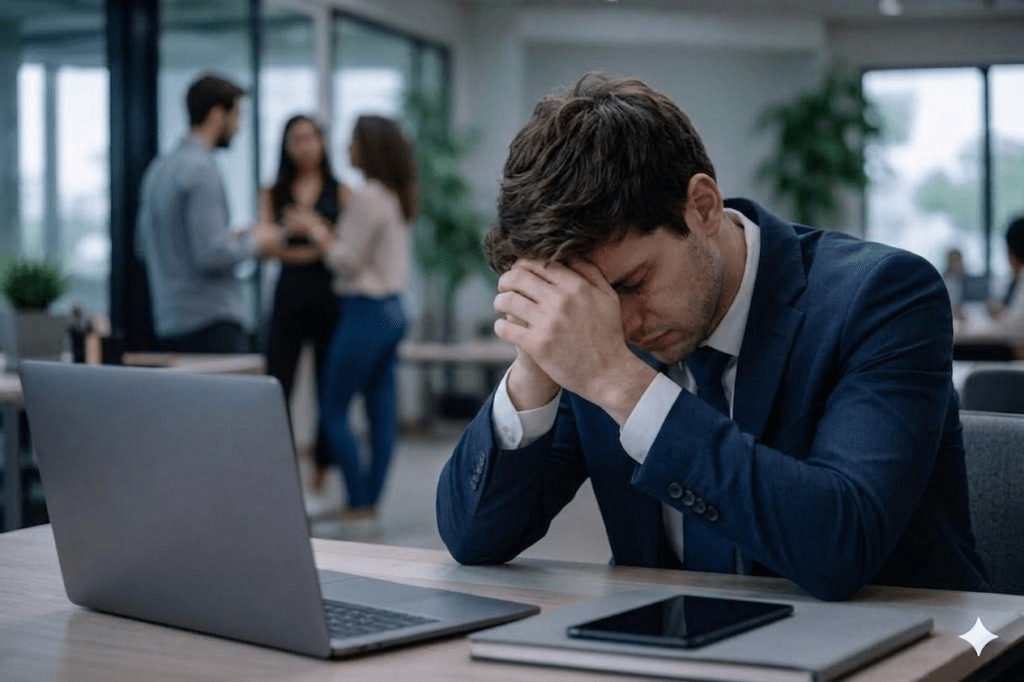
I would leave situations feeling mentally drained without fully understanding why. I assumed I wasn’t concentrating enough. I assumed I needed to try harder.
What I didn’t yet realise was that no amount of concentration can replace information that was never heard in the first place.
That misunderstanding followed me through school.
There were moments where confusion was mistaken for disengagement. Times where I appeared inattentive simply because I had missed critical context. And because I hadn’t disclosed my hearing loss, I rarely had the language to explain what was happening.
One moment from high school has stayed with me for years.
I was in Year 9, standing at the blackboard with friends, drawing and joking around before class. Another student came over and started scribbling over my drawing, and I responded in typical teenage fashion, with a swear word and a laugh.
What I didn’t realise was that the teacher had already entered the room.
I hadn’t heard the door open.
I hadn’t noticed the change in noise level.
I hadn’t picked up on the shift in atmosphere that everyone else immediately recognised.
Then, suddenly, I was told to leave the classroom.
In that moment, everything felt disorienting. Not because I questioned the consequence, but because I hadn’t even been aware of the situation unfolding around me.
What stayed with me wasn’t the discipline itself, but the emotional aftermath, the shame of realising I had been reacting without full information.
It was one of the earliest times I began to understand what it meant to be constantly one step behind, trying to piece together a world that others were hearing in full while I was only receiving fragments.
Living With Progressive Hearing Loss
Around this period, I was diagnosed with otosclerosis affecting my left ear, and the plan was to eventually undergo a stapedectomy when I was older.
At 19, I had the surgery.
The recovery was challenging, particularly the severe vertigo that followed. Eventually, some hearing was restored, but not in a stable or lasting way.
Then, without warning, everything changed again.
I experienced sudden vertigo, and just like that, the hearing in my left ear was gone.
Completely gone.
To this day, I still don’t know exactly what caused it.
From that point onward, I was living with unilateral hearing, relying entirely on my right ear, which itself was gradually affected by the same condition.
There were no straightforward solutions available. And so I adapted, as best I could.
But adaptation has limits.
University, Work, and Listening Exhaustion
University, Work, and the Weight of Effort
University brought new challenges. Studying Mathematics and Computer Science required intense focus, and lectures were particularly demanding.
Trying to listen, process complex information, and take notes simultaneously often felt impossible. Eventually, I arranged support through the disability services so I could focus fully on listening while someone else took notes.
Even with support, the experience remained exhausting.
Workplaces and interviews presented similar challenges. I was able to function, but it required significantly more effort than anyone observing from the outside would have realised.
And throughout all of this, I continued doing what had become second nature.
I hid my hearing loss.
There were periods during this time that were emotionally difficult in ways I didn’t fully understand at the time. Moments where I questioned direction, motivation, and what the point of continuing forward really was.
But I kept going.
Eventually, I made a decision that would change the direction of my life. I enrolled in a Diploma of Audiometry, which ultimately led me into the field of hearing care.
And then, in 2017, after more than two decades of living with significant hearing loss, I received a cochlear implant in my left ear.
Everything changed, not in a way that was simple or immediate, but in a way that was deeply meaningful.
What the Audiogram Doesn’t Show
The audiogram is an essential clinical tool. It tells us what someone can hear under controlled conditions.
But it does not tell us what it costs them to hear in real life.
It does not show the effort required to follow conversation in noise.
It does not capture listening fatigue.
It does not reflect cognitive overload.
I remember a workplace training session years ago where I made every effort to set myself up for success. I arrived early and chose a seat at the front of the room to maximise my chance of hearing clearly.
At first, I felt prepared.
But as the session progressed, the presenter moved constantly around the room. My access to speech became inconsistent, and I found myself relying heavily on adjusting my hearing aid settings and mentally filling in gaps.

Despite everything, I thought I was keeping up.
At one point, I asked a question about something I believed had not yet been covered.
The response was immediate and blunt:
“I’ve just spent the last ten minutes explaining that. You were obviously not paying attention.”
In that moment, I felt completely exposed.
Because from my perspective, I had been paying more attention than anyone else in the room. I had been working harder, not less.
But none of that effort was visible.
That is the challenge of hearing loss. The external behaviour can look identical whether someone is engaged or overwhelmed.
What people don’t see is the internal workload.
This is what listening fatigue feels like, not disengagement, but depletion; like a marathon runner who has given everything but collapses just before the finish line.

The Cochlear Implant Experience
In 2017, I received a cochlear implant after many years of progressive and profound hearing loss.
I still remember the first sound I heard during activation.
A simple pedestrian crossing signal.
A small, repetitive tap… tap… tap…
It was an ordinary sound in an extraordinary moment.
The experience of hearing again in that way is difficult to describe without resorting to metaphor, but the closest I can come is this:
It felt like stepping out of a blurred, black and white, incomplete version of the world and suddenly seeing it with colour, clarity and definition again.

Not perfect clarity. Not instant normality. But access.
Access to sound I had not experienced in decades. High-frequency detail. Spatial awareness. Music in stereo again.
Music, in particular, became something new entirely. Songs I had known for years revealed details I had never heard before. It was both familiar and unfamiliar at the same time.
But it is important to be honest about something often misunderstood.
A cochlear implant, much like a hearing aid, does not remove effort.
It reduces barriers, but listening still requires work.
And that distinction is important.
What I’ve Learned
Over time, both my personal experience and my clinical work have reshaped how I understand hearing loss.
Listening is not passive.
It is active, effortful, and often exhausting.
Many people never communicate when they are struggling, because they have become experts at hiding it. They learn to cope silently, often at the expense of their own wellbeing.
The audiogram, while essential, is only one piece of a much larger picture.
Real-world hearing involves complexity that cannot always be captured in a test booth.
And perhaps most importantly, small changes in communication can make a significant difference, how we speak, how we pause, how we check for understanding, and how we acknowledge effort.
Sometimes, the most powerful thing we can say is simply:
“What you’re experiencing makes sense”
Practical Takeaways
Over the years, I’ve come to believe there are a few things that meaningfully improve outcomes for people with hearing loss.
Asking better questions matters. Not just “How are you hearing?”, but “When is it hardest?” and “What situations do you avoid?”
Listening fatigue should be acknowledged and normalised, not dismissed.
Validation is powerful. Being understood often matters as much as being treated.
Self-advocacy changes lives. Small adjustments in communication and environment can significantly reduce effort.
And families and communication partners play a critical role in shaping outcomes, often more than any device alone.
The Power of Advocacy
The most important shift in my journey was not technological, it was behavioural.
It was the decision to stop hiding my hearing loss.
For years, I tried to blend in. To appear as though nothing was wrong. To avoid drawing attention to my difficulties.
But eventually I realised something important:
When you hide your hearing loss, you also hide your needs.
And when people don’t know your needs, they cannot support you.
So I began to communicate more openly.
Simple adjustments made a meaningful difference, asking people to face me when speaking, choosing quieter environments, requesting repetition when needed.
And surprisingly, people responded well.
Not perfectly, but positively.
The change was not in my hearing.
The change was in my environment.
And that shift was life changing.
Final Reflection
As clinicians, it is easy to focus on devices, thresholds, and test results.
But hearing care is about much more than that.
It is about how people experience their lives.
How they participate.
How they connect.
How they feel in the world.
And perhaps most importantly, it is about giving people the confidence to say:
“This is what I need.”
Because at the end of the day, improving hearing is only part of the goal.
Improving life is the real one.









Leave a Reply