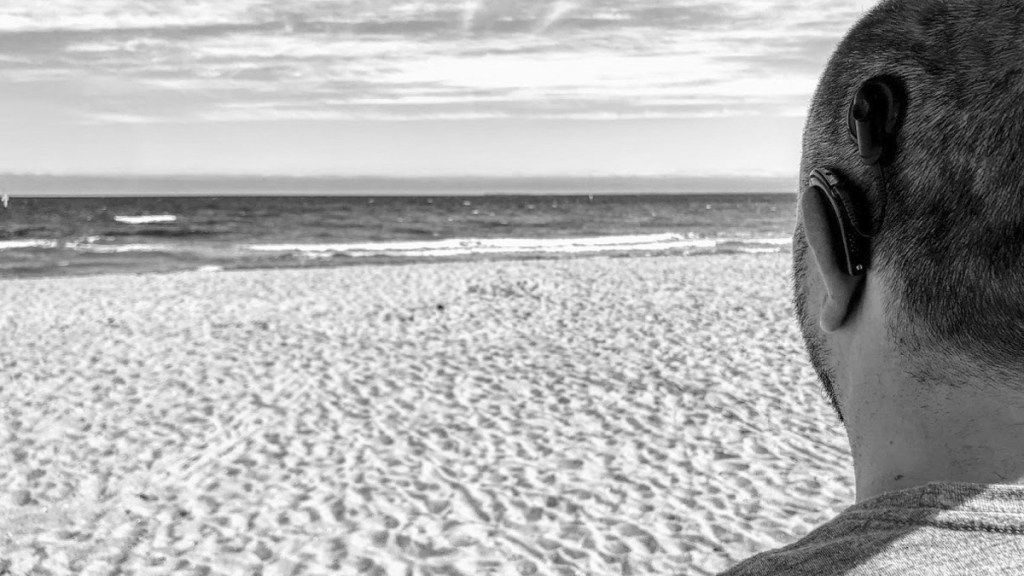
For the majority of my working life I was trying to cope with the challenges of deterioting hearing loss. I did not have alot of support or understanding from my employer or my peers. I had spent so much of my life trying to deny my hearing loss that now I was unprepared to deal with it, working and trying to raise a family. I was struggling to cope and realised that something had to change or I would drown. I began to study a course which would hopefully allow me to move into a career which I felt my life experiences with hearing loss definitely made me suitable for.
About 1 year after I began my course in Audiometry I lost my job. At the time my wife and I were expecting our 4th child and coincidentally enough at this same time my hearing specialist advised me that he could no longer continue as my clinical supervisor. Without supervision I could not complete my course so I was in a panic to find a clinic willing to take on a student while at the same time trying to find a new job.
I was lucky that I was able to quickly find employment with Dick Smith which was perfect for a tech-nerd like me and left me time to dedicate to my studies and trying to find a new clinic to do the practical components of my course.
I emailed every hearing clinic I knew of and was subsequently contacted by Dr Elaine Saunders, from Blamey Saunders hears, who was interested in meeting with me. At the end of our meeting, Dr Saunders not only offered me clinical supervision but also part time work as an intern audiometrist.
Over time I gained more responsibility at Blamey Saunders hears and became a full time employee where I would consult with clients to assess their hearing and fit them with our hearing aids; this allowed me to leave the role at Dick Smith. Due to a passion I have for hearing aid technlogy, my job role was extended to include product management for assistive listening devices (ALDs).
My role as an audiometrist was not an easy one. Part of my role involved conducting speech testing with clients, which was something I could only do by using a Roger Pen, which is a wireless microphone that the client would wear around their neck. The Roger Pen would stream the client’s voice directly to my hearing aid. Team meetings were still a little challenging but I was lucky that I was working with people who fully understood the effects of hearing loss plus, once again my Roger Pen enabled me to catch the majority of what was discussed.
Blamey Saunders hears was a very different working environment to what I was used to. From the first day I was encouraged that my experiences with hearing loss were an assett as they gave me a unique perspective when counselling clients. My opinions were sought after and respected in regards to matters of hearing and hearing aids. (For example the benefits of telecoil and why ALD’s were so important when considering hearing aids.) Dr Saunders asked me on numerous occasions to accompany her on public speaking events and to share my story and experiences to those in attendence. It was during one of these speaking engagements at the Leo Baeck Centre that I was presented with a token of thanks which was quite unique, a tree named in my honor to be planted in Israel. I will forever be indebted to Dr Saunders, Professor Peter Blamey and my Blamey Saunders hears family for their trust, encouragement, respect and support.
In 2016, after many lengthy discussions with some of the audiologists at Blamey Saunders hears, I decided to investigate whether I would be suitable for a cochlear implant. This was a decision that took a very long time to make, especially given that the first ever advice I was given about a cochlear implant was to avoid one at all cost. There was also the financial aspects to consider plus, as with most surgical procedures, there were risks involved.
It had been 26 years since I lost the hearing in my left ear. From the study involved in my audiometry course plus the personal research I had conducted, I was very aware that the longer a hearing loss is left untreated, the harder the road to recovery. But had I already left it too long? My left ear had received no auditory stimulation for most of my life. There was a very good possibility that I would get little or no benefit from the implant.
After much deliberation, I decided to begin the assessment process and see how far it would take me, fully expecting at every step of the way that I would not be a suitable recipient. In November 2016, to my surprise, I was informed that I was indeed suitable and the next thing I knew I was presented with consent forms to sign. I decided to go for it as I had little to lose and so much to potentially gain.
As I was going through the public health system, I expected to go onto a lengthy waiting list so I was shocked to receive a letter as early as December 2016 stating that my surgery was scheduled for early 2017
I received my cochlear implant at the Royal Eye and Ear Hospital on February 23rd 2017 and my switch on day was about 2 weeks later on the 9th March.







 Talking Hearing Loss
Leave a reply to My Story (Part IV) – Talking Hearing Loss Cancel reply