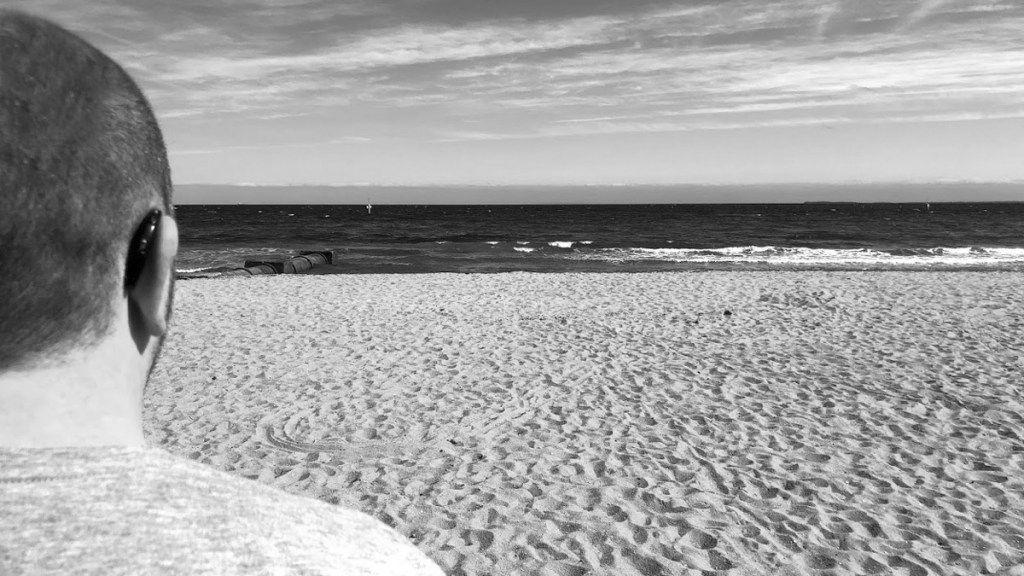
Who am I? I’m a forty-something year old guy from Melbourne, Australia. I’m a husband and a dad. I’m a nerd for technology and an even bigger nerd for the Marvel Cinematic Universe, Star Wars, Harry Potter and horror movies. I love classic rock music. I am an aspiring writer (currently have the ultimate fantasy/sci-fi/horror epic saga as a work in progress). I work for a hearing aid company called Blamey Saunders hears as an Audiometrist and Assistive Listening Devices Product Manager.
I am profoundly deaf. I use a Phonak Naida V90 UP hearing aid in my right ear and a Cochlear Nucleus 6 Cochlear Sound Processor in my left ear. Without these devices, I hear nothing!
I still remember the very moment I discovered that I had a hearing loss. I was about 13 years old and our family doctor held a tuning fork up to each of my ears and asked me if one side was louder than the other. Up until this point in time I was not aware that anything about me had changed what so ever so I’m guessing that my parents must have noticed something, hence this particular appointment. As the vibrating fork was held to my left ear I remember thinking to myself ‘Hang on a second…why can’t I hear that properly?’ I recall going home that day and listening to various sounds around the home; covering and uncovering my right ear as if I needed to convince myself that this wasn’t just a bad dream.
My mother was also diagnosed with a hearing loss when she was in her early teens. She had corrective-surgery which unfortunately was unsuccessful and left her with permanent profound hearing loss. This was something that was treated as a source of embarrassment by her family and so Mum was always encouraged to hide her ears (and hearing aids) under her hair and never speak of it.
Given my mother’s history, whatever it was that had caused my hearing loss was most likely hereditary and because I didn’t know any differently I believed that I could (or should) try to hide my hearing loss from anyone who didn’t already know about it.
When I was 14, I was fitted with a hearing aid for my left ear. Now being a typical awkward teenager whose sole life mission was just to fit in, there was no way in a million years I was going to be seen in public let alone high school with a hearing aid. Every six months or so, I would get called out from class to see a visiting audiologist who would test my hearing. I would try to hide this from my school friends; making up some lie as to where I had been. I used to dread those appointments and even recall thinking that maybe if I tried really, really, really hard, I could make myself do better during the next hearing test.
While I was far from being a problem child, now that I look back, I wonder how many of my so-called ‘behavioral issues’ came down to the simple fact that I was just not hearing that well at school.
I was referred to an Ear, Nose and Throat specialist and diagnosed with a condition called otosclerosis. At the time I remember being told that it usually affects both ears and thinking to myself that I was lucky that I still had one good ear. Despite this, there was always the thought in the back of my mind that I was different to everybody else at school but I really didn’t feel like I had anyone that I could confide in about it so it remained my secret, my problem and ultimately my burden.
Fast forward now to the end of high school. I was about to begin a university degree and during the summer break beforehand, I was scheduled for a stapedectomy to correct the hearing impairment in my left ear.
This was my first ever surgical procedure so I was naturally nervous and scared, but there was also the nagging thought that this type of operation actually made my mother’s hearing worse so ‘What if it happens again?’ My surgeon had advised us that there was only a 1 in 8000 chance of complications and in my mother’s case, the operation should have been delayed until she was older.
Feeling a bit more reassured, I had my stapedectomy and remember waking up to the most awful sense of vertigo and nausea ever; it felt like I was on a crazy amusement park ride that would never stop.
Although the procedure was a success and I regained about 70% of the hearing in my left ear, about 2-3 months after my surgery something went wrong. One moment I was feeling fine and the next I was hit by a sudden and severe bout of vertigo. I don’t know what it was that occurred (I vaguely recall hearing mention of something called labyrinthitis) but whatever it was permanently wiped out all of the hearing in my left ear.
[Part II]







 Talking Hearing Loss
Leave a reply to My Story (Part II) – Talking Hearing Loss Cancel reply