I love a good podcast. There is nothing I enjoy more on my commute to or from work than to tune into my favourite podcasters; my favourite being John B Allen, more commonly known as Mr Ballen. On 20th May 2025 Mr Ballen uploaded to his ‘Mr Ballen’s Medical Mysteries’ channel a story titled Maximum Volume (Apple Podcasts | Amazon Music | Spotify).
After a successful overseas tour, an American rock guitarist comes home with a troubling affliction. All of a sudden, his hearing is extremely sensitive – like everything is turned up to 11. When it doesn’t go away, he’s forced to give up everything he loves, including music. Trapped in his own personal hell, he desperately tries to find an answer before it becomes too much to bear.
This is a truly tragic and heart-breaking story about a young musician who suffers from hyperacusis
Hyperacusis and Recruitment – What’s the Difference?
When we talk about hearing loss, most people assume it’s all about not hearing enough. But for some people, certain sounds don’t just come through—they hit like a freight train. If you’ve ever found everyday sounds painfully loud or experienced a sudden jolt from a noise that went from nothing to overwhelming, you might be dealing with hyperacusis or recruitment.
They’re often confused with each other, but they’re not the same thing. In fact, understanding the difference between them can make a big impact—especially when it comes to hearing aid fittings and overall hearing health.
So, what is hyperacusis?
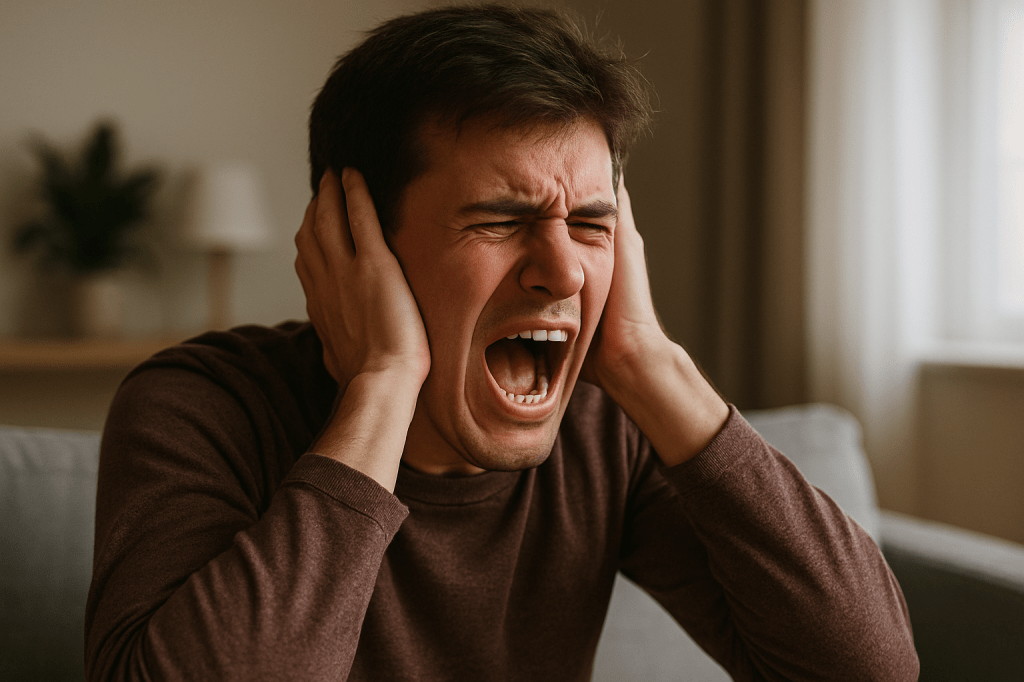
Hyperacusis is a heightened sensitivity to sound. Everyday noises—cutlery clinking, a baby crying, a vacuum cleaner—can feel exaggerated, sharp, even painful. And we’re not talking about loud concerts or sirens here; it’s often ordinary sounds at normal volumes that feel unbearable.
This isn’t about having “super hearing”—it’s more about how the brain interprets sound. Something in the auditory system becomes overly reactive, and the brain starts treating normal sound as a threat.
Hyperacusis can be triggered by a range of things, including:
- Noise exposure
- Head trauma
- Anxiety or stress
- Certain neurological conditions
- And sometimes, it shows up without a clear cause at all
People with hyperacusis don’t always have hearing loss, but the two can overlap.
What about recruitment?
Recruitment is something that often comes with sensorineural hearing loss—which is the kind of hearing loss caused by damage to the hair cells in the inner ear.
Here’s what happens: soft sounds may be completely inaudible, but once a sound reaches a certain point, it feels suddenly too loud. There’s not much in-between. You go from silence to discomfort in the space of a few decibels.
This is one of the reasons why some people with hearing loss say their hearing aids make things “too loud”—it’s not that the aids are faulty; it’s that their ears can’t handle the sudden jump in volume due to recruitment.
Key differences at a glance
| Hyperacusis | Recruitment | |
|---|---|---|
| What causes it | Often brain-based or neurological | Damaged hair cells in the inner ear |
| Hearing loss | May or may not be present | Always linked to hearing loss |
| How it feels | Normal sounds feel painfully loud | Sounds jump from too soft to too loud suddenly |
| Which sounds | Often specific (cutlery, voices, alarms) | Usually all sounds once they reach a certain volume |
| Management | Sound therapy, counselling, desensitisation | Careful fine-tuning of hearing aids |
Why it matters
If you’ve got hearing loss and you’re struggling with loudness discomfort, knowing whether it’s hyperacusis or recruitment is crucial. The approaches to managing each are quite different.
For hyperacusis, it’s often about gently retraining the brain to tolerate sound again—usually through gradual exposure and sound therapy. For recruitment, the focus is on getting the hearing aid settings just right, often using compression strategies that amplify soft sounds without making loud ones unbearable.
I’ve seen people give up on their hearing aids because they thought they just couldn’t tolerate them—when really, they were dealing with recruitment, and the solution was a matter of fine-tuning.
In summary
Both hyperacusis and recruitment can make hearing loss harder to live with—but they’re manageable once you know what you’re dealing with.
If you think you might have either, don’t tough it out or assume it’s just part of getting older. Talk to a hearing care professional who understands these conditions. The right support makes a world of difference.
Have you experienced either hyperacusis or recruitment? I’d love to hear your story—drop a comment or get in touch.







 Talking Hearing Loss
Leave a comment