
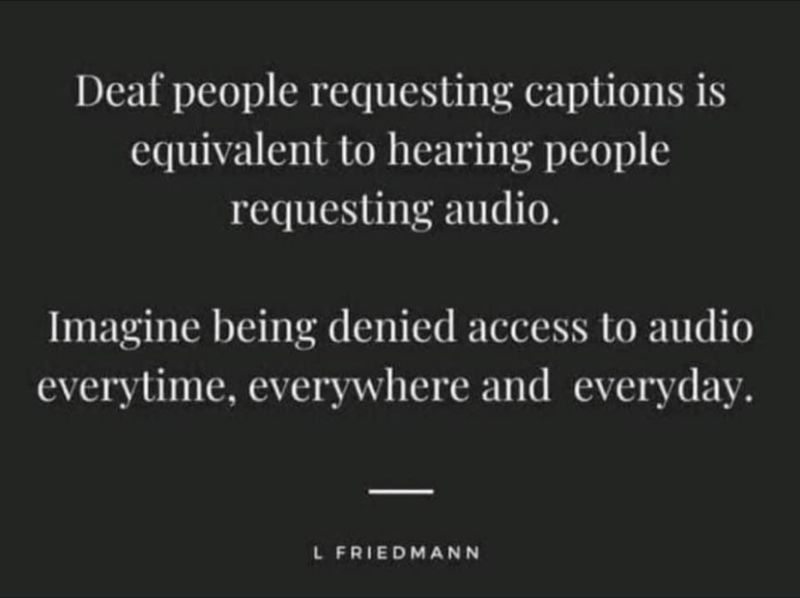
Many years ago, we had a guest over and we all decided to watch a movie together on the television. About 5 minutes into the movie, she asked if we could turn the captions off as she found them annoying.
In my mind, this whole scenario played out where I said “Hey if you want the captions off then I want the sound muted. If I can’t understand the movie then why you should be able to!!”
What actually happened was that I just shrugged, turned off the captions and then played Candy Crush on my phone while everyone else watched the movie.
In an increasingly digital world, accessibility is a fundamental right that ensures everyone, regardless of their abilities, can participate fully in society. For people with hearing loss, captioning plays a critical role in bridging communication gaps, enabling access to information, and fostering inclusion. Captioning, also known as closed captioning or subtitles, is essential for people who have hearing loss for several reasons:
- Access to Information: Captioning allows people with hearing loss to have access to the same information that is being conveyed through spoken language. It enables them to fully participate in conversations, classes, meetings, and other activities where verbal communication is necessary.
- Clarity: Captioning provides clarity to the spoken word by providing a written text display of what is being said. This is particularly helpful for people with hearing loss who may struggle with understanding spoken language, especially in noisy or acoustically challenging environments.
- Understanding: Captioning helps people with hearing loss to understand the context of a conversation or event playing out in a movie. The captions can describe that ‘the sound of rain can be heard striking the window’ or that ‘Suspenseful music is playing’ as the person on the screen is making their way through a dark hallway.
- Independence: Captioning allows people with hearing loss to be more independent in their daily lives. They do not need to rely on others to interpret what is being said or to provide a summary of the conversations or event.
- Inclusion: Captioning promotes inclusion and accessibility for people with hearing loss, enabling them to participate fully in society and enjoy the same rights and opportunities as their hearing peers.
Currently captioning options for people with a hearing loss are limited. We are dependent upon the movie or tv program we’re watching to have captions available, which means when attending the cinema we rely on special captioned movie sessions. With all the video’s being shared by people on social media platforms such as TikTok, without captions we miss alot of the context of what’s been uploaded.
Technological advancements continue to enhance the quality and availability of captioning. Automatic Speech Recognition (ASR) and Artificial Intelligence (AI) are making it easier and more affordable to provide accurate captions across various platforms. As these technologies evolve, the future looks promising for even more seamless and widespread access to captioned content.
Here’s a challenge for you… try to spend a day where every video, movie or tv program you watch has NO SOUND!
How enjoyable was the experience?
Captioning is more than just a convenience; it is a vital tool for inclusion and accessibility for people with hearing loss. By transforming auditory content into written words, captions open up a world of information, entertainment, and participation that might otherwise be inaccessible. As we strive for a more inclusive society, the importance of captioning cannot be overstated. It empowers individuals, promotes independence, and ensures that everyone has the opportunity to engage fully with the world around them.





 Talking Hearing Loss
Leave a comment